RangeLeagues: Casual remote competitive shooting leagues
What it is, in one sentence
RangeLeagues is a casual remote competition league platform that lets users have an easier, free and significantly less intimidating way of participating in competitive shooting sports, on their own ranges, on their own time.
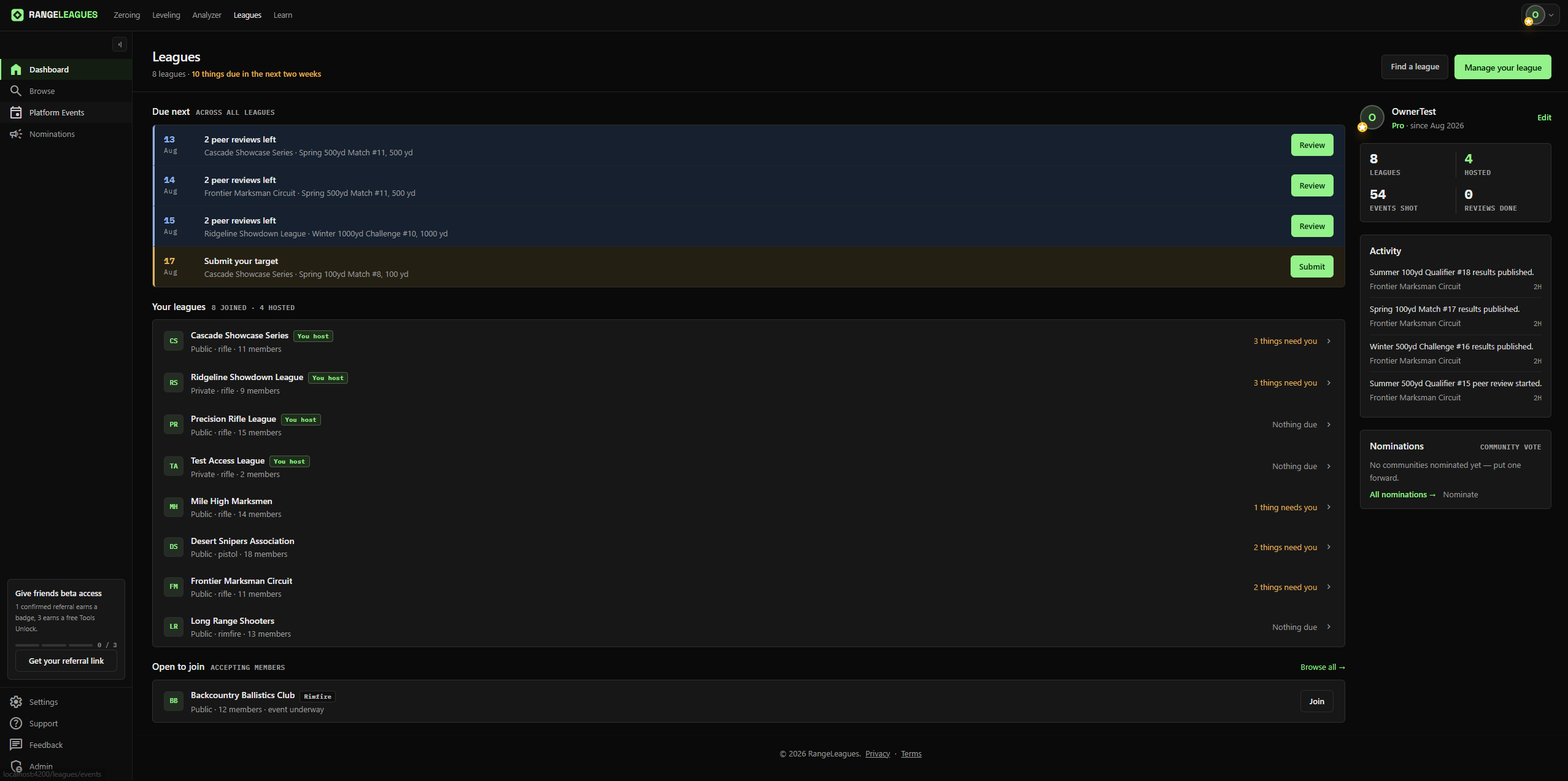
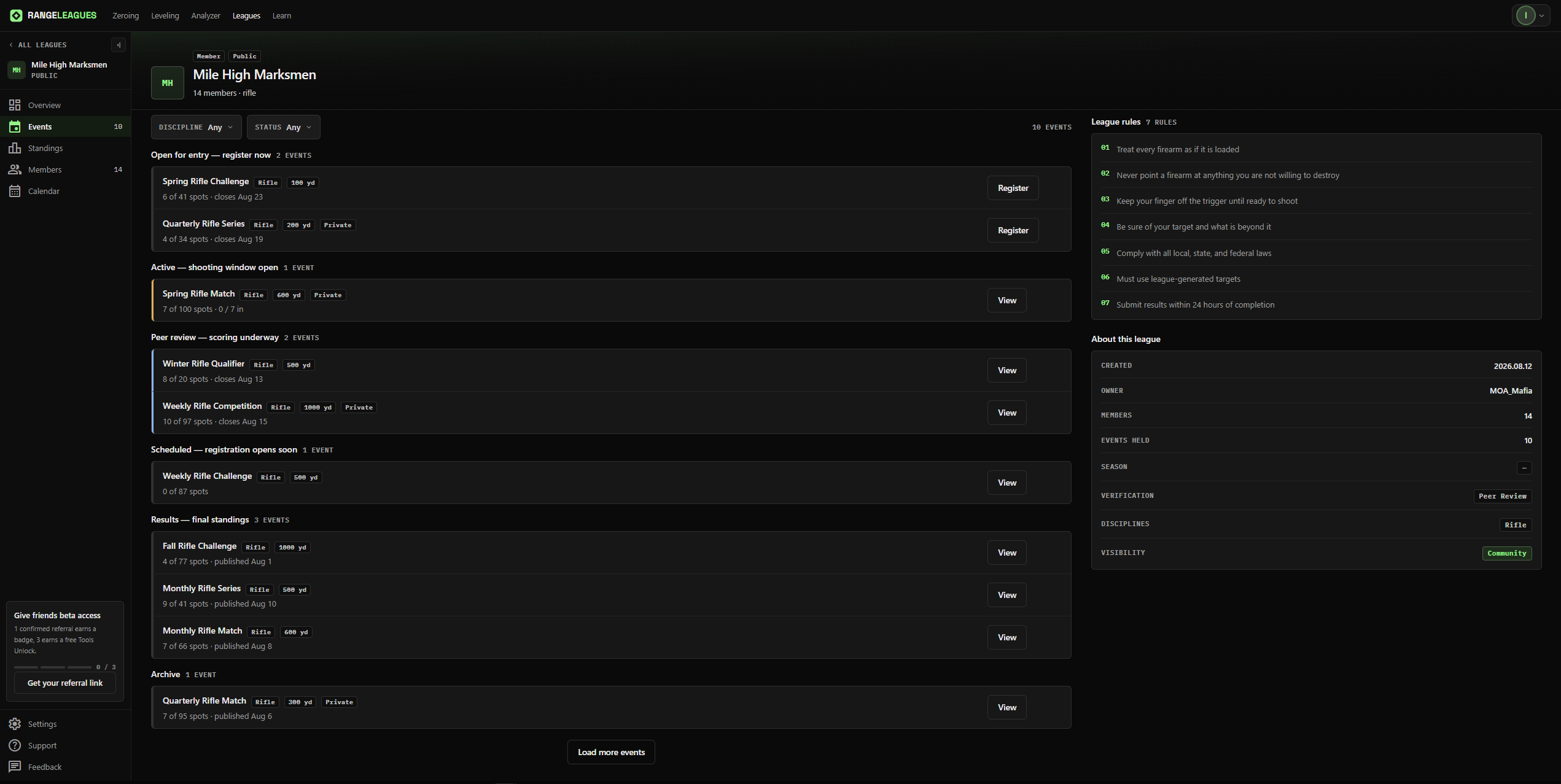
Leagues
League types
Private leagues are hosted by one person who invites people they already shoot with. Hosting requires Pro. Free members can join up to 4 per league via invite link — and free members are limited to one private league at a time, so joining a second means upgrading.
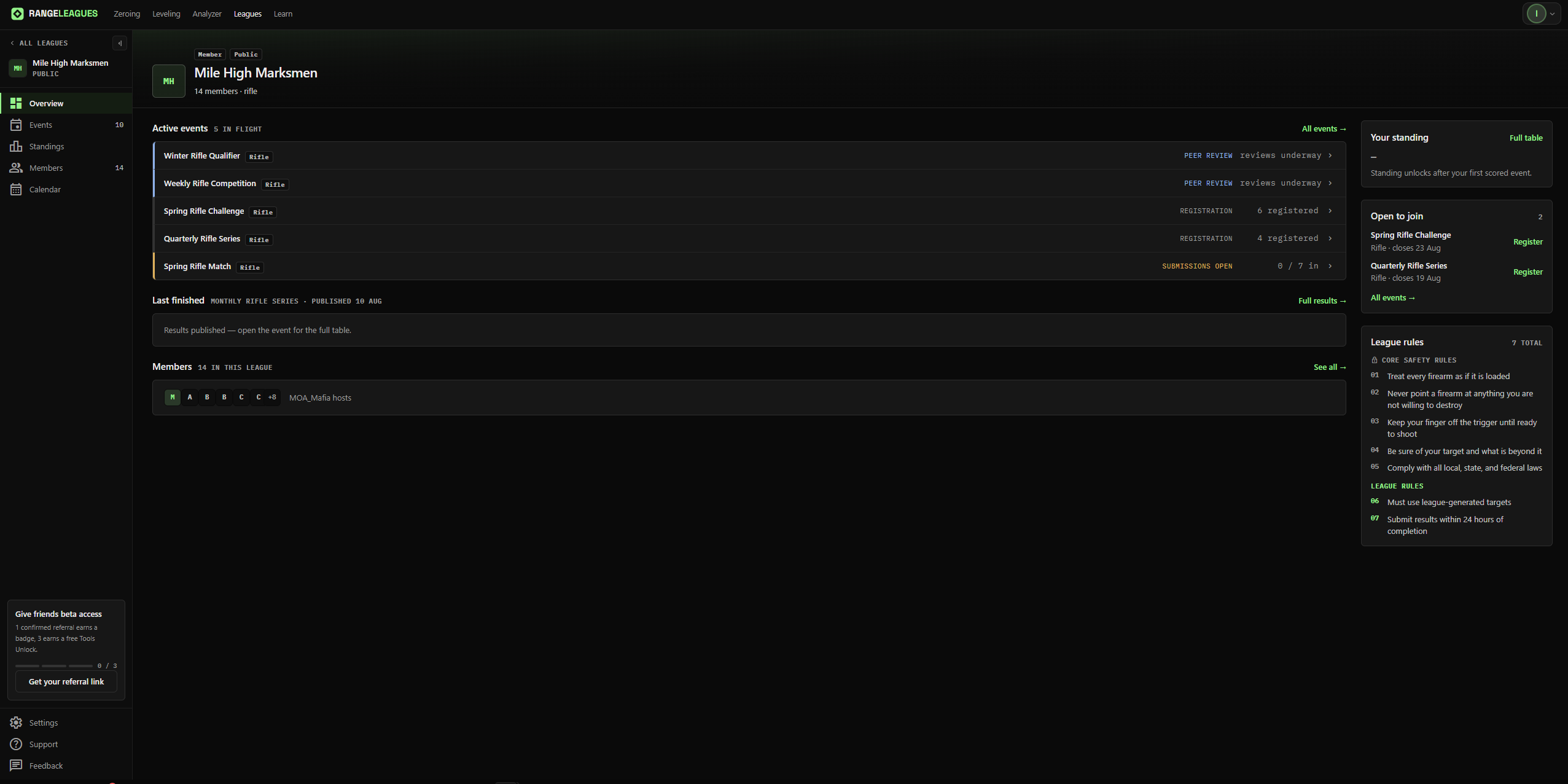
Every league has a small role hierarchy: an owner, optional moderators who help run things day to day, and members. Moderators can manage events and review/moderate submissions; only the owner can change league settings or hand off ownership.
Events, and how a remote match runs start to finish
An “event” inside a league is a postal match — a scored competition that doesn’t require everyone to be in the same place at the same time.
Smart Targets
Every RangeLeagues event runs on “smart targets” — you print the exact target the event issues you, and its code is tied to you and that event specifically, so it can’t be swapped, reused, or shot twice. That’s what makes an asymmetric remote match work: everyone’s shooting a standardized, QR-verified sheet, so a submission from a backyard in Texas and one from a range in Connecticut are directly comparable. At launch there are two target types.
Five-Dot Precision puts five aim points on one sheet, one round each, no do-overs — your score is the sum of how far each shot lands from the center of its own dot, so it rewards a clean cold-bore shot over a lucky group.
Accuracy & Precision is the more familiar format: one aim point, a full string of rounds on it, and the score splits group size (how tight your shots are together) from center offset (how close that group sits to point of aim) — precision and accuracy tracked and scored separately, then summed for rank. This type of target can be scored based on Precision and Accuracy which measures how tight the group is and how close to the center the group is as well. Another scoring method for this target is Group size, measuring the MOA of the shot group.
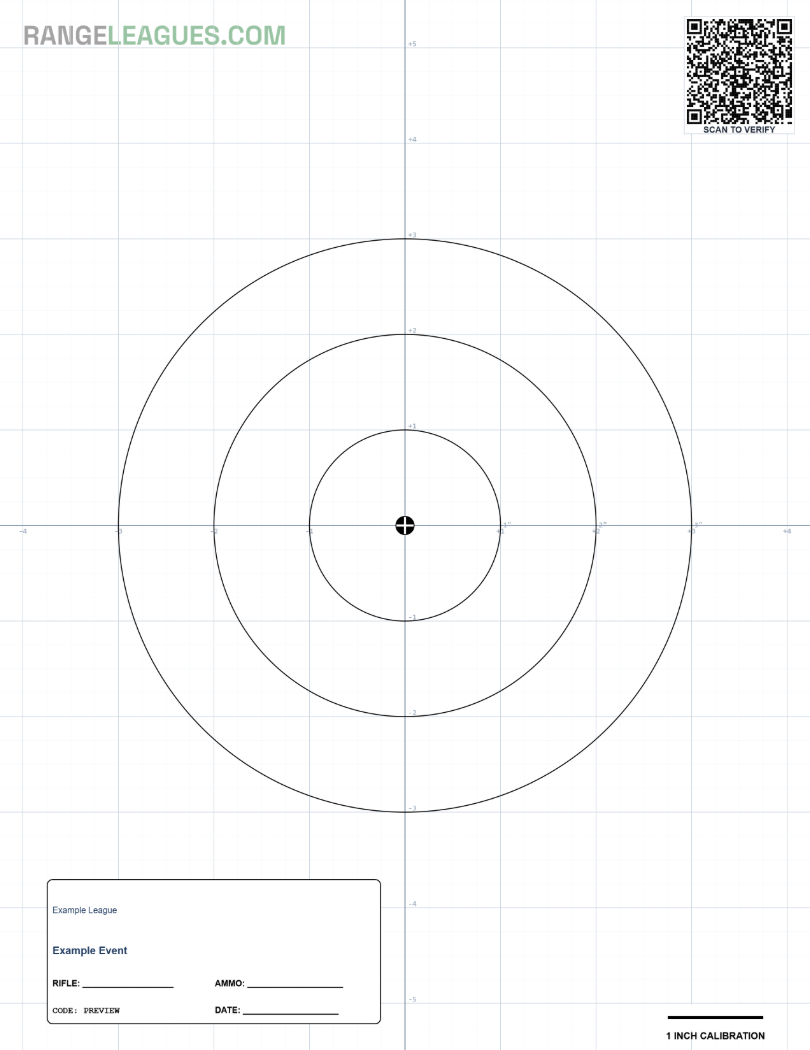
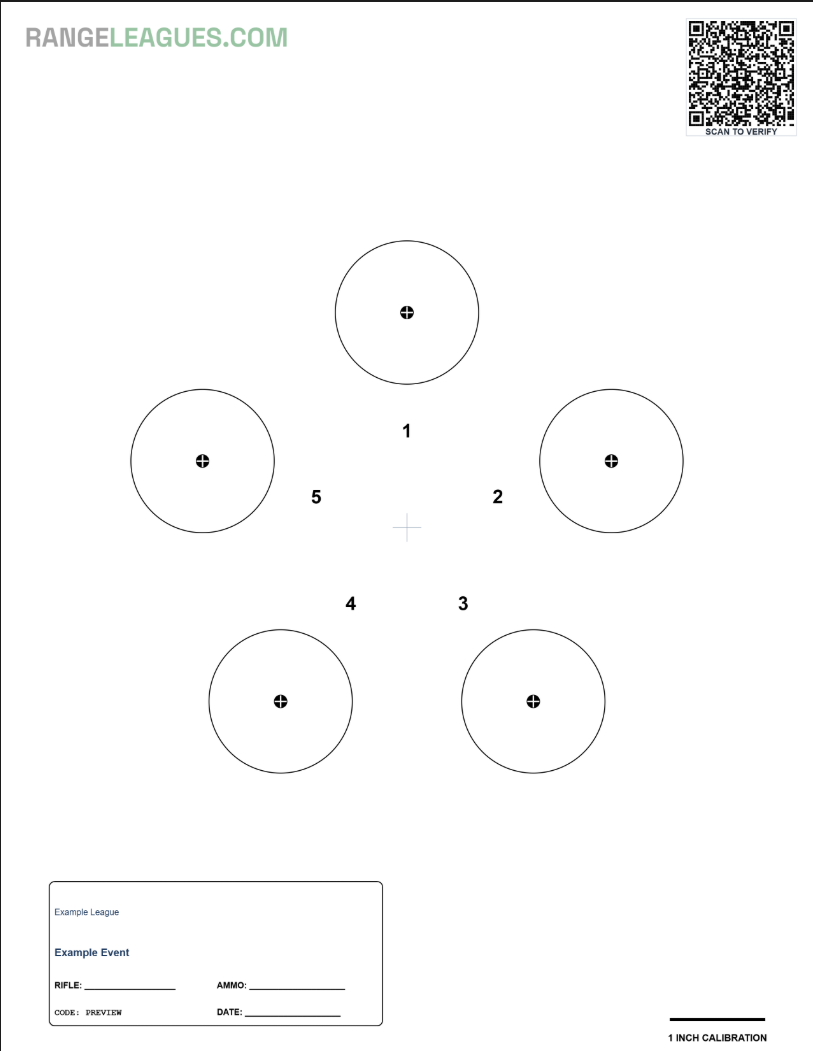
All Target templates are subject to change and may change depending on real world parameters such as distance to target, etc.
Signup. The event opens for a signup window. Members register ahead of the shooting window opening.
Submission window. Instead of a single match day, the event stays open for a span of days. Each participant prints the match’s target, shoots it whenever their schedule and range access allow within that window, and submits a photo when they’re done.
Submission. Submitting uses the same marking flow as the standalone analyzer: mark point of aim, mark shots, done. Behind that simple flow, verified event targets carry a unique code (each printed target gets its own identifier), and each one can only be used for a single submission, so the same physical target can’t be reused or resubmitted.
Server-side scoring. This is the part that makes the results trustworthy: for league submissions, the app never trusts whatever score your own phone calculated. When you submit, the server independently recomputes the score from your raw marked points. Your local screen is just a preview of what’s about to be sent, not the record of truth.
Certification and review. Before a submission counts toward standings, it goes through a peer certification step. Most events run in peer mode, where a small group of independent members certify the submission (the number scales with league size, up to three); leagues can also configure an official-review mode where a single designated official signs off instead. There’s also a blind re-plot method: a reviewer re-marks the same photo independently, without seeing the original marks, and if their result lands within a tight tolerance of the original, that counts as certification too. Anyone can flag a submission with a reason, which routes it into a moderation queue instead of silently accepting or rejecting it.
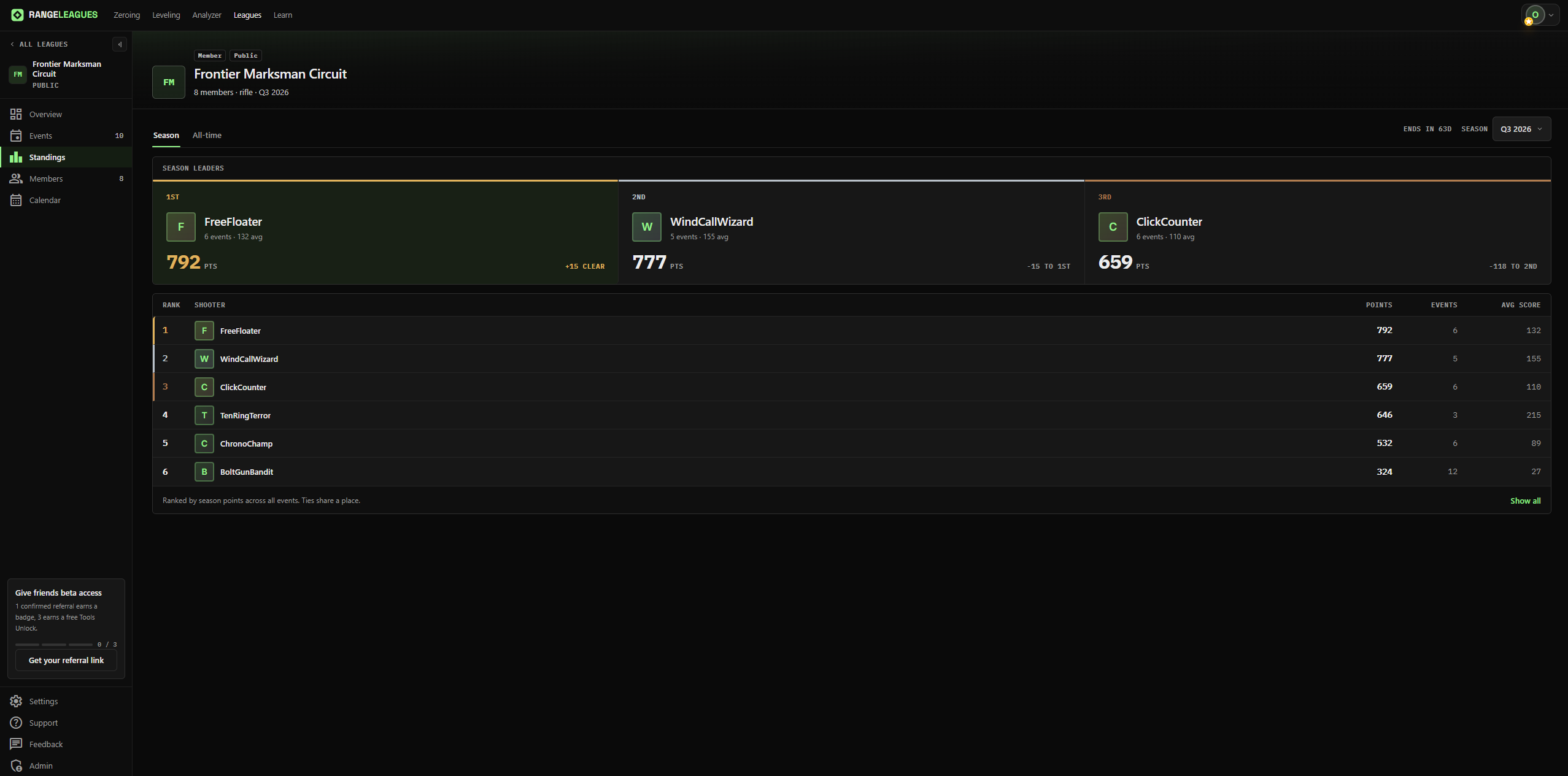
Results and standings. Certified scores roll into the league’s season standings as accumulated points across events, so the ranking reflects a season of shooting, not a single best (or worst) day at the range.
Why it’s built this way
None of this is trying to replace a real sanctioned match, at least not yet. The point is a middle ground: casual enough that anyone can join from their own range on their own schedule, but with enough verification built in (unique targets, server-side recompute, peer certification, flagging) that the results mean something to the people in the league, instead of just being an honor-system spreadsheet.
The tools underneath all of this
Leagues are the point, but they’re built on a small set of utilities that also work completely on their own, for free, with no league involved.
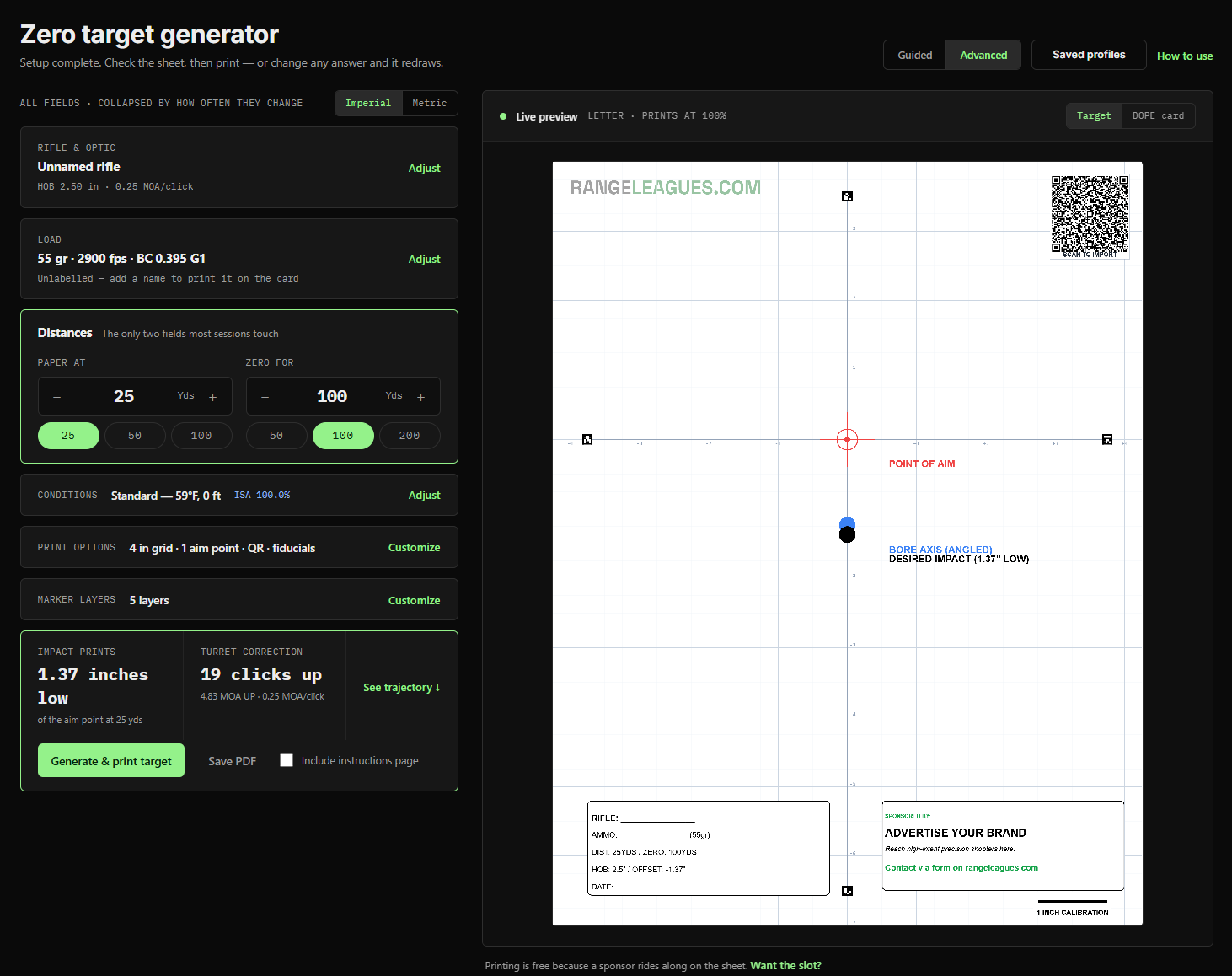
Target Generator
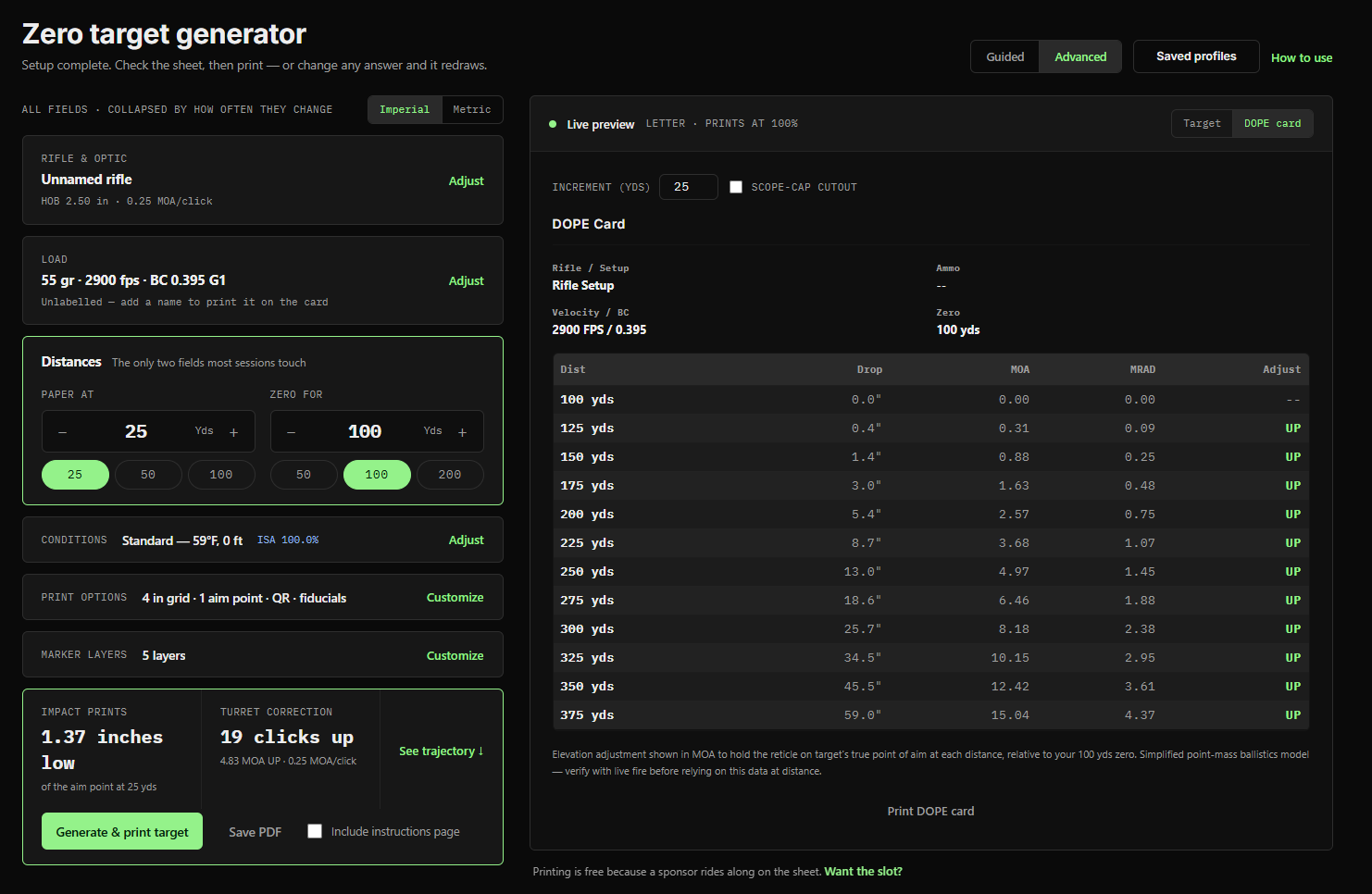
Enter your rifle, ammo, optic, and distances, and it prints a target with the correct aim point already calculated for your setup — plus a 1-inch calibration line and a QR code that reloads your exact settings later. League event targets are generated the same way, just per-event instead of per-person.
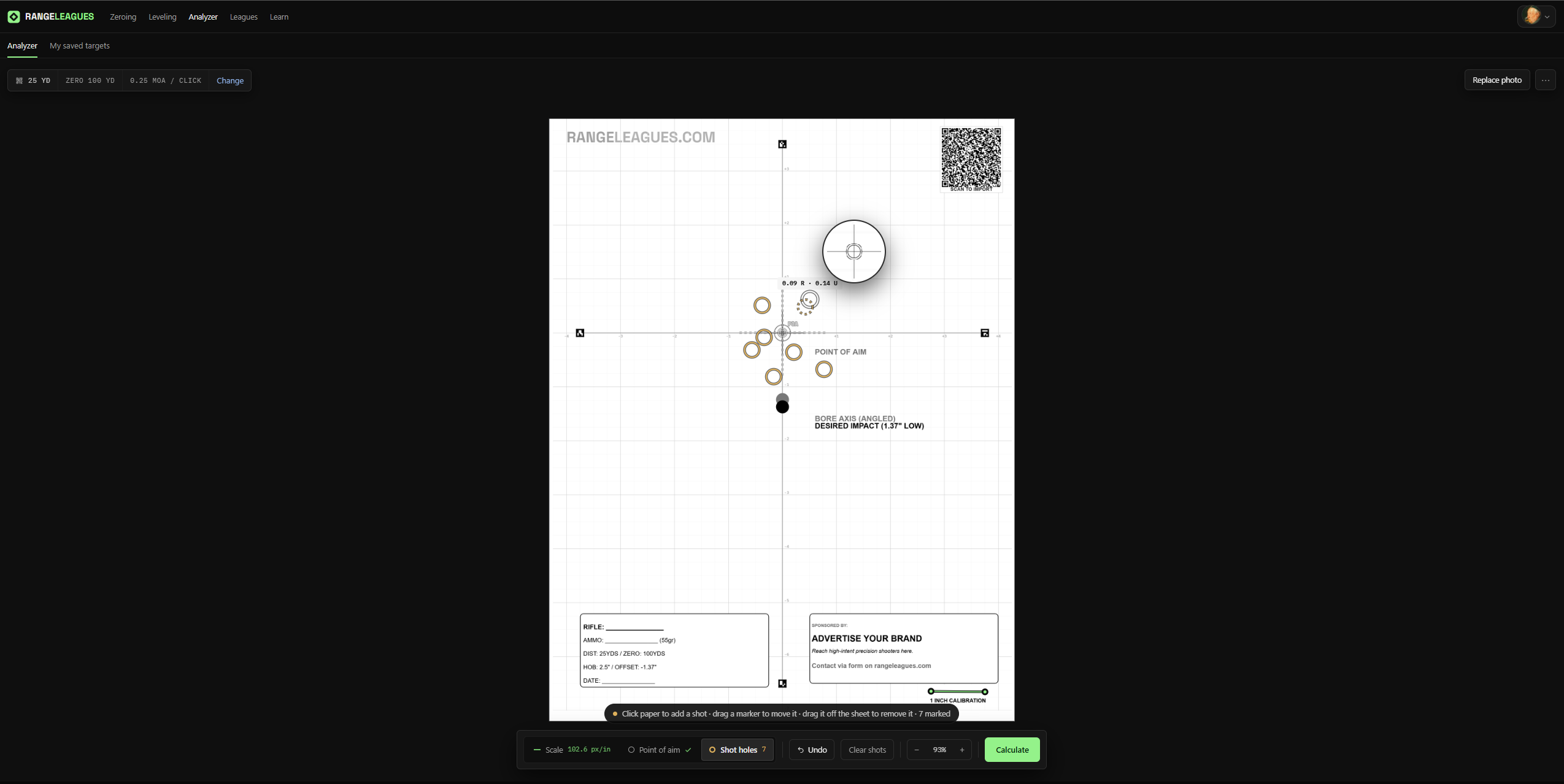
Shot Group Analyzer
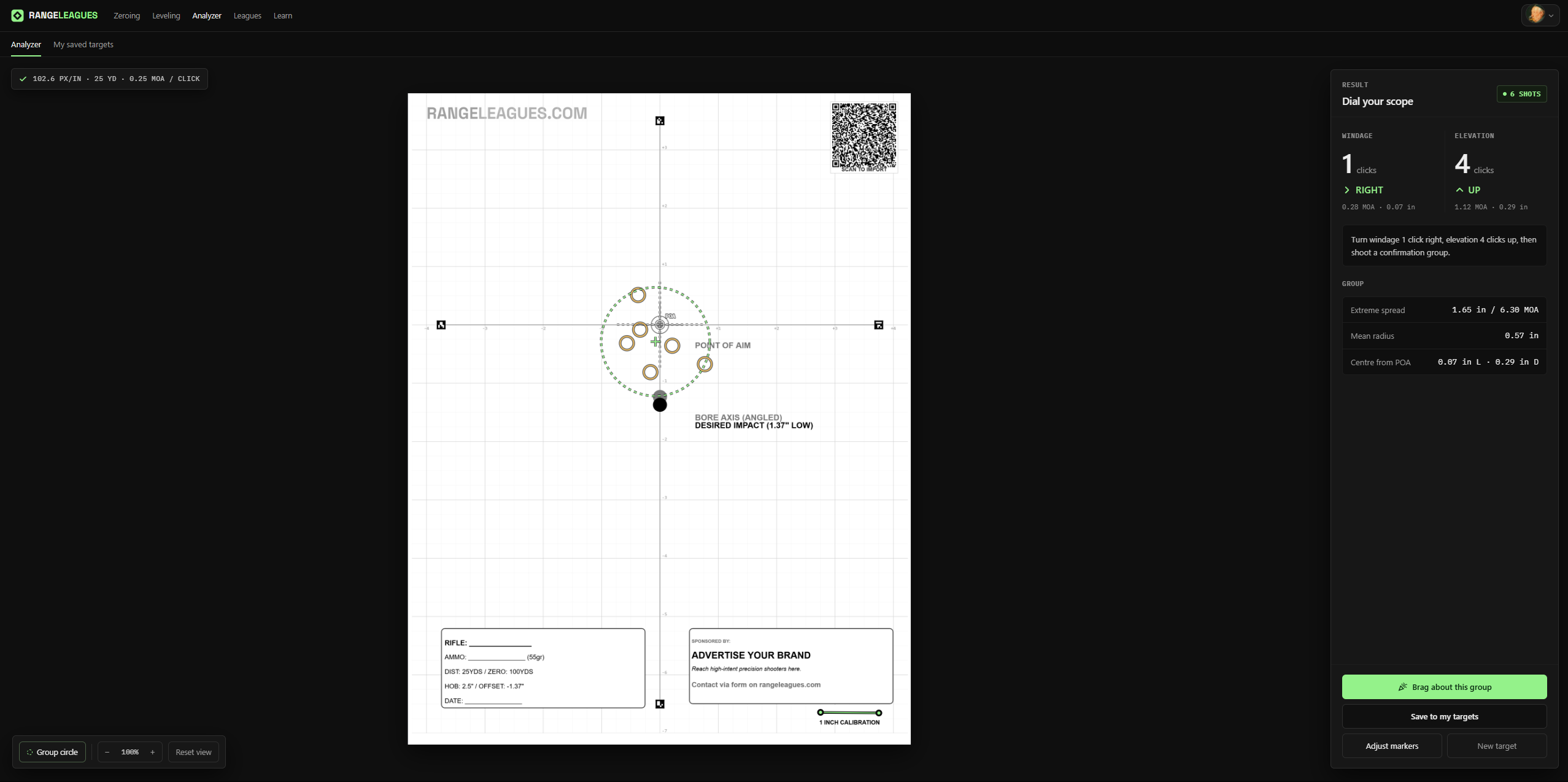
Photograph a target, and the app calculates group size, scope correction, and a score from the photo — auto-calibrating off the printed line or QR code where it can, falling back to a couple of taps where it can’t. This is the same marking and calibration flow used for league submissions; the difference is what happens to the score afterward. A standalone save trusts your device’s calculation as a personal record. A league submission gets recomputed and verified server-side before it counts.
Saved Targets
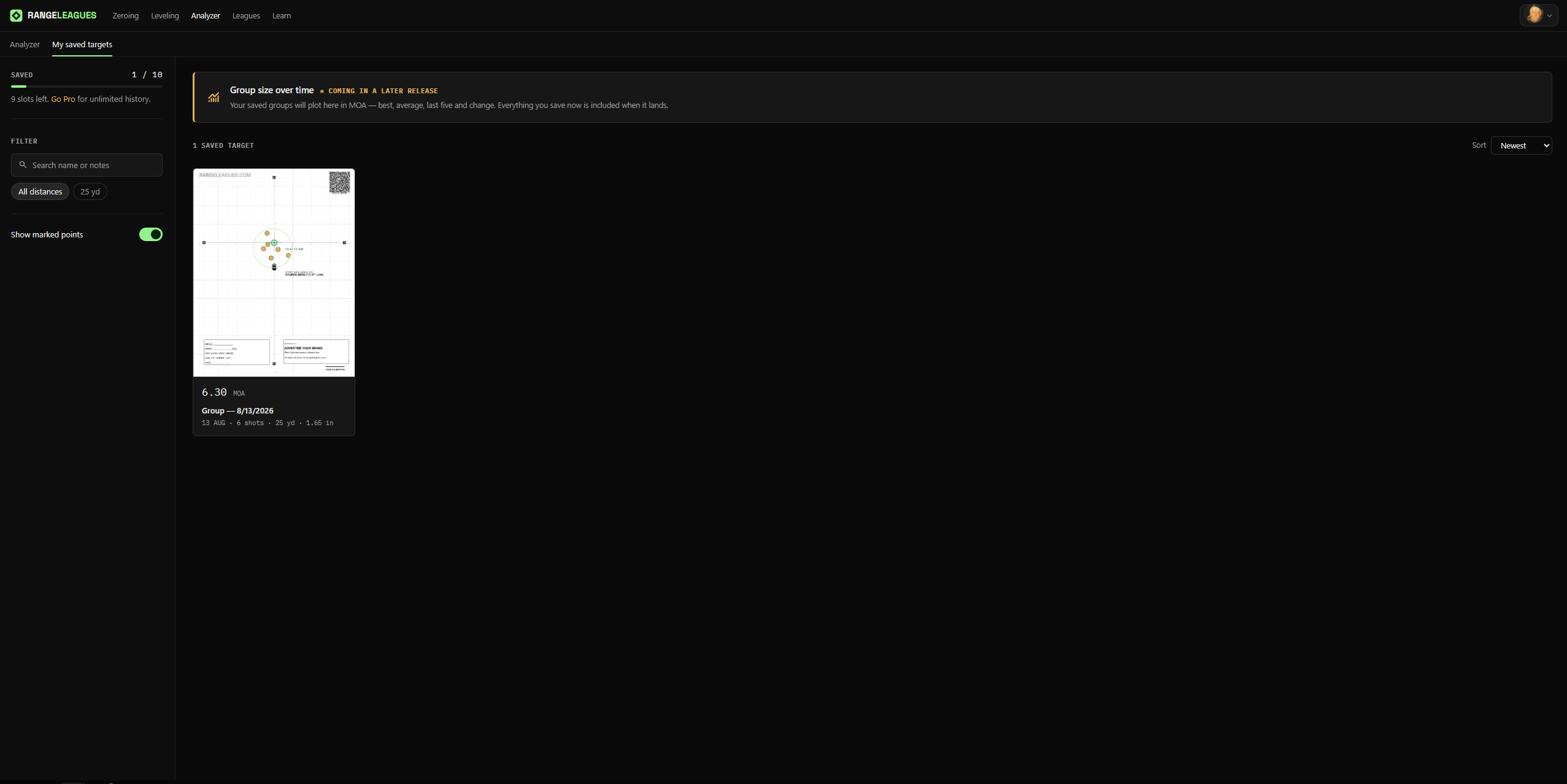
Analyzed targets can be saved to your account — photo, group size, score, rifle/caliber, date, position — and filtered later (“every group with this rifle”). Personal history, separate from league submissions.
DOPE cards and trajectory visualizer
Smaller utilities off the same ballistics engine: a printable drop chart per distance, and a graph of bullet drop and transonic range for your setup. Includes a scope cover cutout generator as well.
All the tools above — target generator, analyzer, saved targets, DOPE cards, trajectory visualizer — are free and live right now, no invite needed: rangeleagues.com
Leagues are in private beta. Community leagues (free, open-join) are the current way in — drop a comment or DM if you want in on one, or want to see a league spun up for your own community. Private league hosting is built but waiting on Pro to go on sale at a later date so it’s not live yet, beta testers receive lifetime access to Pro as thanks for testing the app.
- Yes, I own a printer
- Yes, but I DON’T own a printer
- No, not interested